From Chatbot to Agent: Building a Conversational PIX Assistant with LangGraph and FastAPI
The Gap Between Chatbots and Agents
Most LLM demos stop where things start to get interesting: the model generates a nice text response, and that’s it. But the real value of an LLM inside a product is not what it says — it’s what it does after speaking.
Over the last few months I’ve been building a side project that deliberately crosses that line: a conversational PIX assistant that interprets natural language commands in Portuguese and executes real banking operations. The user types “list my pix keys” or “pay this QR Code”, and the system classifies the intent, routes it through a state graph, calls the banking API, and answers with a humanized message — with authentication, caching, persistence, guardrails, and full observability along the way.
This post walks through the architecture and the trade-offs behind each decision. All code snippets are real, taken straight from the repository.
Context: From the Classroom to a Side Project
The timing wasn’t accidental. I’m currently enrolled in a post-graduation program in Applied AI Engineering, and the module on LLM API integration (taught by Erick Wendel, who actively encourages students to build in public) introduced exactly the tools I had been wanting to try hands-on: LangGraph for agent orchestration and OpenRouter for multi-model access.
At the same time, my day job is building Banking-as-a-Service products. Combining the two worlds was the natural move: take the agent patterns from the classroom and stress-test them against the kind of integration complexity I see every day in banking — JWT authentication, idempotency, transactional state, audit trails.
The result is two repositories:
- banking-llm — the backend: a FastAPI service hosting a LangGraph state machine
- chat-llm — the frontend: a Vue 3 chat SPA that talks to it
What the System Does
A single endpoint, POST /chat, receives a message in natural language and returns a humanized answer. Behind it, six intents are supported:
| Intent | Description |
|---|---|
list_keys |
Lists active PIX keys on the account |
read_key |
Fetches details of a specific PIX key |
pix_withdraw |
Executes a PIX transfer to a key |
brcode_preview |
Decodes and validates a PIX QR Code |
pix_payment |
Full QR Code payment (preview + transfer) |
guardrail |
Safety validation against prompt injection |
Architecture Overview
The service follows a layered design, with the LangGraph machine sitting between the HTTP layer and the domain services:
┌─────────────────────────────────────────────────────────┐
│                   HTTP Layer (FastAPI)                  │
│  POST /chat  →  ChatRequest → GraphProcessor.ainvoke()  │
├─────────────────────────────────────────────────────────┤
│                   Graph Layer (LangGraph)               │
│  StateGraph[GraphState]                                 │
│    ├── guardrail        (Prompt injection guard)        │
│    ├── identifyIntent   (LLM-as-router)                 │
│    ├── listKeys         (Banking API — list keys)       │
│    ├── readKey          (Banking API — key details)     │
│    ├── pixWithdraw      (Banking API — PIX transfer)    │
│    ├── brcodePreview    (Banking API — QR decode)       │
│    ├── pixPayment       (Orchestrator: preview + pay)   │
│    ├── fallback         (No-op handler)                 │
│    └── chatResponse     (LLM-as-generator)              │
├─────────────────────────────────────────────────────────┤
│                   Services Layer                        │
│    Guardrail · Intent · PixKey · PixWithdraw ·          │
│    BRCodePreview · PixPayment · Response                │
├─────────────────────────────────────────────────────────┤
│               Infrastructure Layer                      │
│    LLMService (Ollama/OpenRouter) · BankingClient       │
│    BankingAuth (JWT ES512) · RedisCacheService          │
│    AsyncPostgresSaver (LangGraph persistence)           │
└─────────────────────────────────────────────────────────┘
Now let’s get into the decisions that actually mattered.
Decision 1: A State Machine, Not a Free-Form Agent
The first architectural fork in the road: should this be a ReAct-style agent that autonomously picks tools, or an explicit state graph?
| Approach | Pros | Cons | Decision |
|---|---|---|---|
| LangGraph state machine | Deterministic routing, auditable path, per-node observability, easy to replay/debug | More upfront design, less “emergent” behavior | ✅ Chosen |
| ReAct agent (tool calling) | Flexible, less code, handles unplanned paths | Non-deterministic, hard to audit, hard to guarantee flow | ❌ |
| Pure prompt chaining | Simple | No conditional logic, brittle | ❌ |
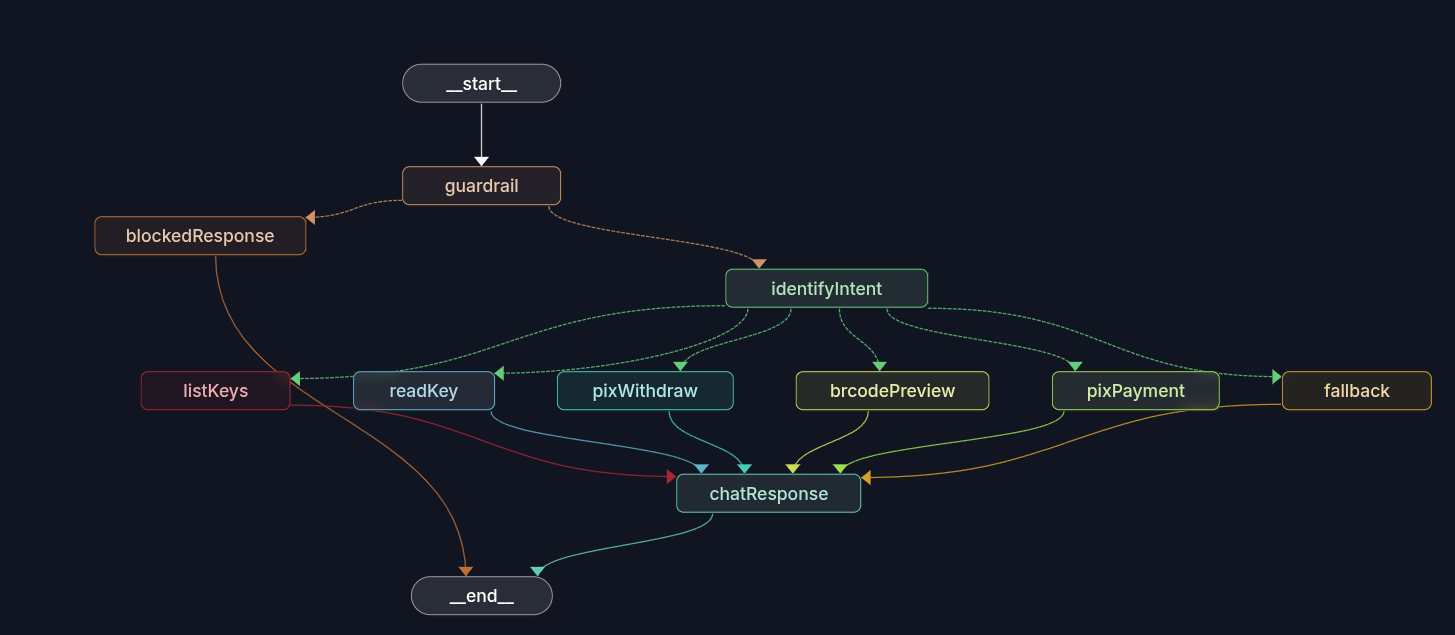
The key insight: when the “tool” on the other side is a real money movement API, non-determinism is not a feature — it’s a liability. I need to guarantee, by construction, that every request passes the guardrail before anything touches the banking API, and that a payment only happens after a preview. A state graph gives me those guarantees as edges, not as hopes baked into a system prompt.
The flow is explicit:
START ──▶ guardrail ──▶ identifyIntent ──(conditional)──▶ listKeys ──────────▶ chatResponse ──▶ END
                                              │                                      ▲
                                              ├──▶ readKey ──────────────────────────┤
                                              ├──▶ pixWithdraw ──────────────────────┤
                                              ├──▶ brcodePreview ────────────────────┤
                                              ├──▶ pixPayment ───────────────────────┤
                                              └──▶ fallback ─────────────────────────┘
Decision 2: The Guardrail Is the First Node, Not a Middleware
Every request enters through the guardrail node, powered by a dedicated safety model (llama-guard3:8b). If the input looks like prompt injection, the graph short-circuits to a blockedResponse node and terminates — the intent classifier and the banking API never even see the message:
workflow.add_conditional_edges(
    "guardrail",
    route_guardrail,
    {
        "blocked": "blockedResponse",
        "safe": "identifyIntent",
    },
)
workflow.add_edge("blockedResponse", END)
Trade-off: an extra LLM call on every message adds latency (visible in the graph_node_duration_seconds metric). But in a system where a successful injection could trigger a financial transaction, a dedicated safety gate at the graph level — independent from the routing LLM — is non-negotiable. Defense in depth beats prompt engineering.
Decision 3: LLM-as-Router with Structured Output
Intent classification is done by the LLM itself, but constrained through structured output. The state defines the contract as a Literal type:
class GraphState(TypedDict):
    messages: Annotated[list[AnyMessage], add_messages]
    command: Literal[
        "list_keys", "read_key", "pix_withdraw",
        "brcode_preview", "pix_payment",
        "brcode_ambiguous", "unknown",
    ]
    ...
Routing is then plain, testable Python — no LLM involved in the decision itself:
workflow.add_conditional_edges(
    "identifyIntent",
    route_intent,
    {
        "list_keys": "listKeys",
        "read_key": "readKey",
        "pix_withdraw": "pixWithdraw",
        "brcode_preview": "brcodePreview",
        "pix_payment": "pixPayment",
        "brcode_ambiguous": "fallback",
        "fallback": "fallback",
    },
)
This split — LLM proposes, deterministic code disposes — is the pattern I’d recommend for any production agent: let the model do what it’s good at (understanding messy natural language), and let code do what it’s good at (enforcing control flow).
Notice the brcode_ambiguous command: when the LLM detects a BRCode but can’t tell what the user wants to do with it, it routes to a safe fallback instead of guessing. Ambiguity is a first-class outcome, not an error.
Decision 4: Dual LLM Provider — Ollama for Dev, OpenRouter for Prod
The LLMService abstracts the provider, so the same codebase runs in two modes:
| Mode | Provider | Model | Why |
|---|---|---|---|
| Development | Ollama (local) | Qwen2.5:14B-Instruct-Q4_K_M |
Free, offline, private — iterate without burning API credits |
| Production | OpenRouter | google/gemini-2.5-flash |
Managed, fast, one API key for many models |
The guardrail model (llama-guard3:8b) also runs locally via Ollama. Swapping providers is a configuration change, not a refactor — the same dependency-injection principle I applied in my local RAG project.
Decision 5: Stateful Conversations Enable Real Payment Loops
Here’s where LangGraph’s checkpointer shines. PIX QR Codes can be issued without an amount — the payer decides how much to pay. Handling that requires a multi-turn conversation with memory:
- User: “pague esse pix copia e cola 00020126…Jesse Pinkman…“
- Assistant: “The QR Code you’re trying to pay belongs to Jesse Pinkman. It has no specific amount associated. How much do you want to pay?”
- User: “pague R$ 5.00”
- Assistant: “Payment completed successfully. End-to-End ID: E49288113… — Amount paid: R$ 5.00 — Status: CREATED”
State is persisted in PostgreSQL via AsyncPostgresSaver, keyed by a thread_id. The HTTP contract is simple: the client sends an X-Thread-ID header; if absent, the API generates one and returns it in the response header for the next turn.
The interesting part is how the intent node handles continuation — it checks the persisted state before calling the LLM:
def _handle_continuation(state: GraphState, messages: list) -> dict | None:
    """Resolve a pending amount from the user's last message, if any."""
    if not (state.get("awaiting_amount") and messages):
        return None
    amount = _extract_amount(str(messages[-1].content))
    if not amount:
        return None
    return {
        "command": "pix_payment",
        "withdraw_amount": amount,
        "awaiting_amount": False,
    }
The key insight: if the user is answering a pending question (“R$ 5.00”), you don’t need an LLM call to figure out the intent — the state already tells you. A regex and a flag beat a token-spending classification, and the flow becomes deterministic exactly where money is involved.
Decision 6: FastAPI as the Backbone
FastAPI was a deliberate choice, and it carries more weight here than just “serving HTTP”:
- Async end-to-end: the graph invocation (
graph.ainvoke), the banking client, Redis, and Postgres are all async — a sync framework would be a bottleneck pretending to be a server. - Pydantic v2 everywhere: request/response contracts (
ChatRequest,ChatResponse), settings viapydantic-settings, and DTOs at the banking boundary. One validation model from edge to edge. - Dependency injection via
app.state: cache and checkpointer are attached at lifespan startup and pulled inside the route — no globals. - Free OpenAPI docs: the interactive Swagger UI at
/docsdoubles as a test harness for the whole graph.
The route itself stays thin — all complexity lives behind the graph:
@chat_router.post("/chat", response_model=ChatResponse)
async def chat(request: ChatRequest, raw_request: Request,
               thread_id: Annotated[str | None, Header()] = None):
    cache = getattr(raw_request.app.state, "cache", None)
    checkpointer = getattr(raw_request.app.state, "checkpointer", None)
    thread_id = thread_id or str(uuid4())
    graph = GraphProcessor(log=logger, cache_service=cache,
                           checkpointer=checkpointer).get_graph()
    result = await graph.ainvoke(
        {"messages": [HumanMessage(content=request.question)]},
        {"configurable": {"thread_id": thread_id}},
    )
    ...
    return JSONResponse(ChatResponse(answer=response_msg).model_dump(),
                        headers={"X-Thread-ID": thread_id})
Decision 7: Observability Is Not Optional
An agent that calls external APIs and moves money without traces is a debugging nightmare waiting to happen. The service is instrumented with OpenTelemetry (opt-in via OTEL_ENABLED, no-op when off):
- Traces: root HTTP span, domain spans per graph node (
graph.intent.identify,pix.withdraw.execute, …), IO spans (banking API, Redis, Postgres), LLM spans with token counts. Exported to Tempo/Jaeger. - Metrics: RED for HTTP plus domain metrics —
pix_operations_total,graph_node_duration_seconds,guardrail_block_total— pushed to Prometheus. - Logs:
structlogJSON with automatictrace_id/span_idcorrelation, shipped to Loki. - Privacy: PIX keys, government IDs, tokens, and secrets are masked in span attributes, metric labels, and logs.
The Grafana stack comes with pre-provisioned dashboards (“Service Overview”, “PIX Operations”), so I can watch per-node p95 latency, guardrail block rates, and LLM token throughput while chatting with the assistant.
My favorite detail: the stack includes a read-only Grafana MCP server — which means another LLM agent can query the telemetry of this agent. Agents observing agents, with a Viewer-only service account.
The Frontend: A Deliberately Thin SPA
The chat UI (chat-llm) is a Vue 3 + Vite SPA with Pinia and TailwindCSS. Its only real responsibility beyond rendering is the thread contract: generate a local UUID for a new conversation, send it as X-Thread-ID, and adopt whatever thread ID the API returns. Unit tests with Vitest, E2E with Playwright. Keeping the frontend thin keeps the conversational logic exactly where it belongs: in the graph.
What I Learned About Trade-offs
Determinism vs. autonomy. The industry hype is on fully autonomous agents. For regulated, money-touching domains, the sweet spot is the opposite: LLMs for understanding, state machines for deciding. Autonomy is a spectrum, and you choose where to sit on it per use case.
LLM calls are a budget. The continuation handler saves one classification call per multi-turn payment. Small win? Sure. But designing flows where the state answers before the model is a habit that compounds — in latency, cost, and predictability.
Guardrails belong in the architecture, not in the prompt. A system prompt that says “don’t follow malicious instructions” is a suggestion. A graph edge that physically prevents reaching the banking API is a control.
Local models are production-grade for dev loops. Qwen2.5:14B quantized handles Portuguese intent classification and response generation surprisingly well. The entire dev cycle runs offline at zero marginal cost — OpenRouter only enters when I need managed scale.
What’s Next
The roadmap is public in the repo: authentication on /chat (after which the assistant can proactively fetch the customer’s accounts), more PIX operations, and a CI/CD pipeline. The foundations — guardrails, persistence, observability — are already in place.
Applied AI Engineers: when your agent’s tools can trigger real-world side effects, where do you draw the line between model autonomy and deterministic control flow?
Full code, ADRs, and setup instructions: github.com/mabittar/banking-llm · Frontend: github.com/mabittar/chat-llm